

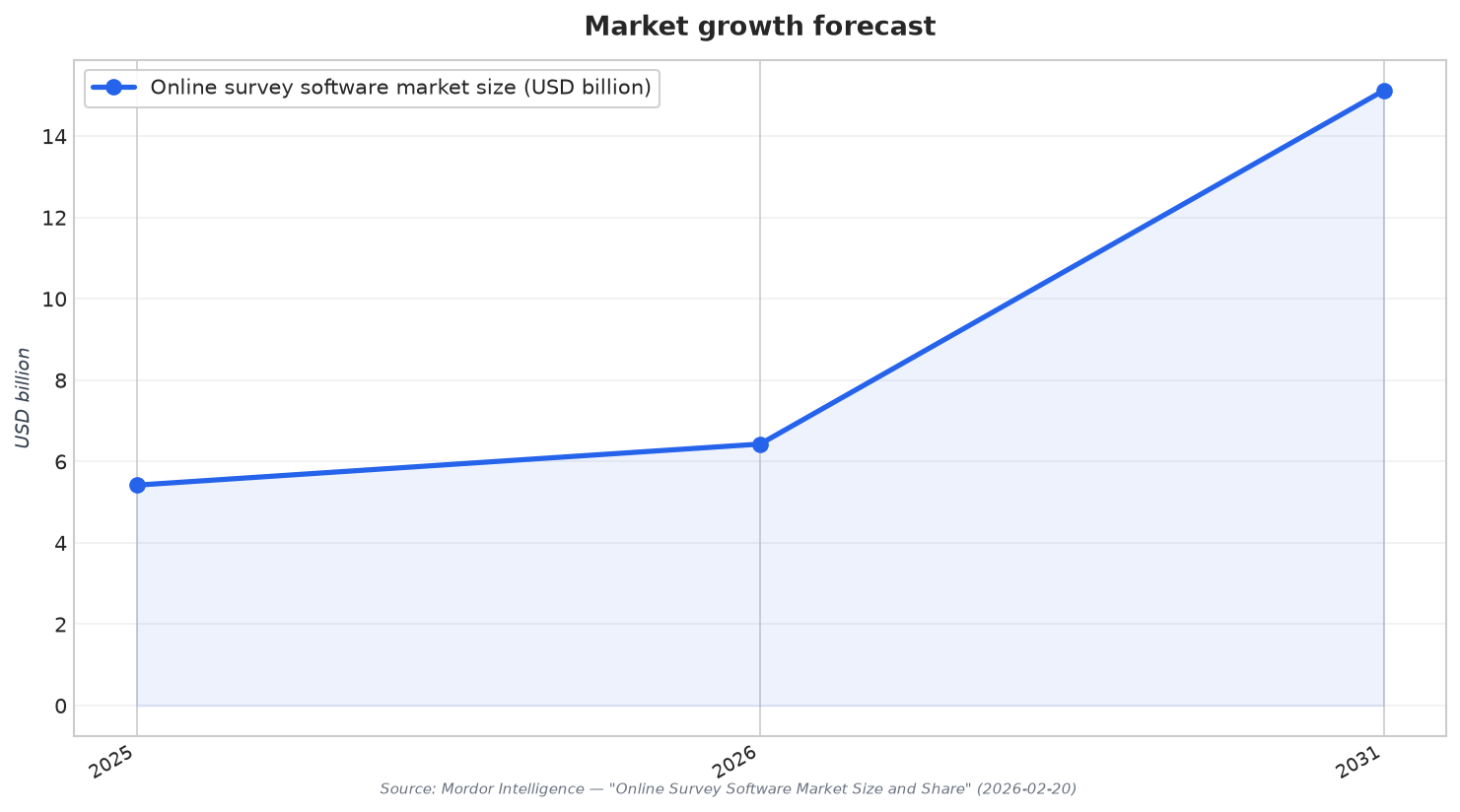
Online surveys are becoming a default workflow for experience management and feedback programs, and the software ecosystem is expanding quickly. Mordor Intelligence projects the global online survey software market to grow from USD 5.42 billion in 2025 and USD 6.43 billion in 2026 to USD 15.12 billion by 2031, with a 18.67% CAGR from 2026 to 2031. Cloud deployment is already the dominant model globally, with cloud solutions at 71.85% of market size in 2025 and cloud spend described as flowing to subscription models at 72.41%. For teams focused on data quality in market research across Southeast Asia, this growth matters because more surveys, more channels, and more automation can increase both reach and the risk of low-quality responses.
Survey fatigue is one of the clearest threats to reliable insights. Multiple sources warn that long or complex surveys can drive fatigue, push people away, and pollute datasets. Luth Research notes that logical flow is critical because respondent fatigue can threaten data quality. Veridata Insights adds that long or overly complex surveys often result in lower-quality responses and that keeping surveys concise and focused improves engagement and response accuracy. Prolific frames the issue through core response-quality dimensions: comprehension, attention, and honesty. If respondents do not understand what is being asked, are not paying attention, or are tempted to respond dishonestly, the results will not be fit for purpose, even if the survey is widely distributed.
A Practical Data-Quality Checklist for Online Surveys
Start with clear quality parameters and a design review. Luth Research recommends defining what “high quality” means for the study, including accuracy, completeness, and consistency. Then scrutinize wording and layout for clarity and engagement, and ensure the survey follows a logical flow to reduce fatigue. Pretests and pilots help identify confusing questions before full launch, including testing alternate versions and collecting participant feedback. Prolific similarly emphasizes comprehension, recommending instructions and preliminary questions to confirm respondents understand what is being asked. These steps are not optional polish; they are foundational controls that prevent avoidable error from entering your dataset in the first place.
Next, monitor behavior during fieldwork and apply systematic cleaning. Luth Research recommends monitoring respondent behavior to spot patterns such as straight-lining or inconsistent answers, and to understand engagement, including whether people abandon the survey. Prolific highlights attention checks and time monitoring, noting that tracking time spent on the survey and on each question can indicate who is skimming versus engaging. Then clean the data by identifying outliers and removing duplicates, which Luth Research lists as key cleaning steps. Veridata Insights also flags fraudulent responses, including duplicate entries and automated bots, and recommends safeguards such as IP tracking, digital fingerprinting, and validation checks. Together, these practices create a defensible workflow for protecting validity when online responses scale.
Finally, align channel strategy with quality goals, not just volume. Globally, Mordor Intelligence reports that email and web links delivered 40.12% of responses in 2025, while social media and messaging apps are forecast to accelerate at 22.09% CAGR. It also states that mobile-first channels such as WhatsApp surveys deliver materially higher response rates, and that Asia Pacific is expected to accelerate at 24.31% CAGR by geography. These are global and regional market signals, not a direct measurement of any single Southeast Asian country. Still, they underline why data-quality controls should travel with your survey wherever it is shared. As distribution becomes easier, quality discipline becomes the differentiator that keeps your findings credible.
Why does survey fatigue threaten online survey results?
What are the core dimensions of data quality to watch in online surveys?
How can teams detect low-quality or fraudulent survey responses?
How fast is the online survey software market growing globally?
How should data quality in market research across Southeast Asia be protected as surveys scale?