Building a reliable online research panel Philippines teams can use year-round starts with scope. The Philippines is an archipelago of 7,600 islands grouped into three major island groups, and consumer behaviour differs between Metro Manila, provincial Luzon, the Visayas, and Mindanao. A panel recruited only in Metro Manila produces Metro Manila data, not national insight. Locale planning should also account for households shaped by overseas work and remittances. As of 2023, approximately 1.96 million Filipinos were working overseas, sending home $38.34 billion annually, which can shift purchasing power in provinces in ways that do not appear in formal income data.
Recruitment and profiling are the backbone of panel quality. Online panels are made of pre-recruited respondents who have agreed to participate in research studies, and that pre-consent supports stronger response rates and more reliable targeting. During registration, panelists provide demographic, geographic, and behavioral details such as age, gender, interests, or product usage. That information allows future studies to match the right respondents to the right briefs. English is widely usable across most urban demographics, which can reduce instrument design complexity, but it does not remove the need for cultural fluency in question design and interpretation.
How to Manage Engagement, Incentives, and Data Quality
Panel management is ongoing operations, not a one-time setup. Building and managing your own research panel requires time and expertise, from recruiting and screening respondents to designing surveys and analyzing results. Many teams use technology-based solutions to enhance data collection accuracy and improve respondent engagement, including online panels, tablets, and instant messaging apps. For panel teams that want a single workflow, panel management platforms position themselves as tools to manage everything from recruitment to reporting, with automated features aimed at maintaining engagement and data accuracy and supporting high-scale, high-speed insight collection.
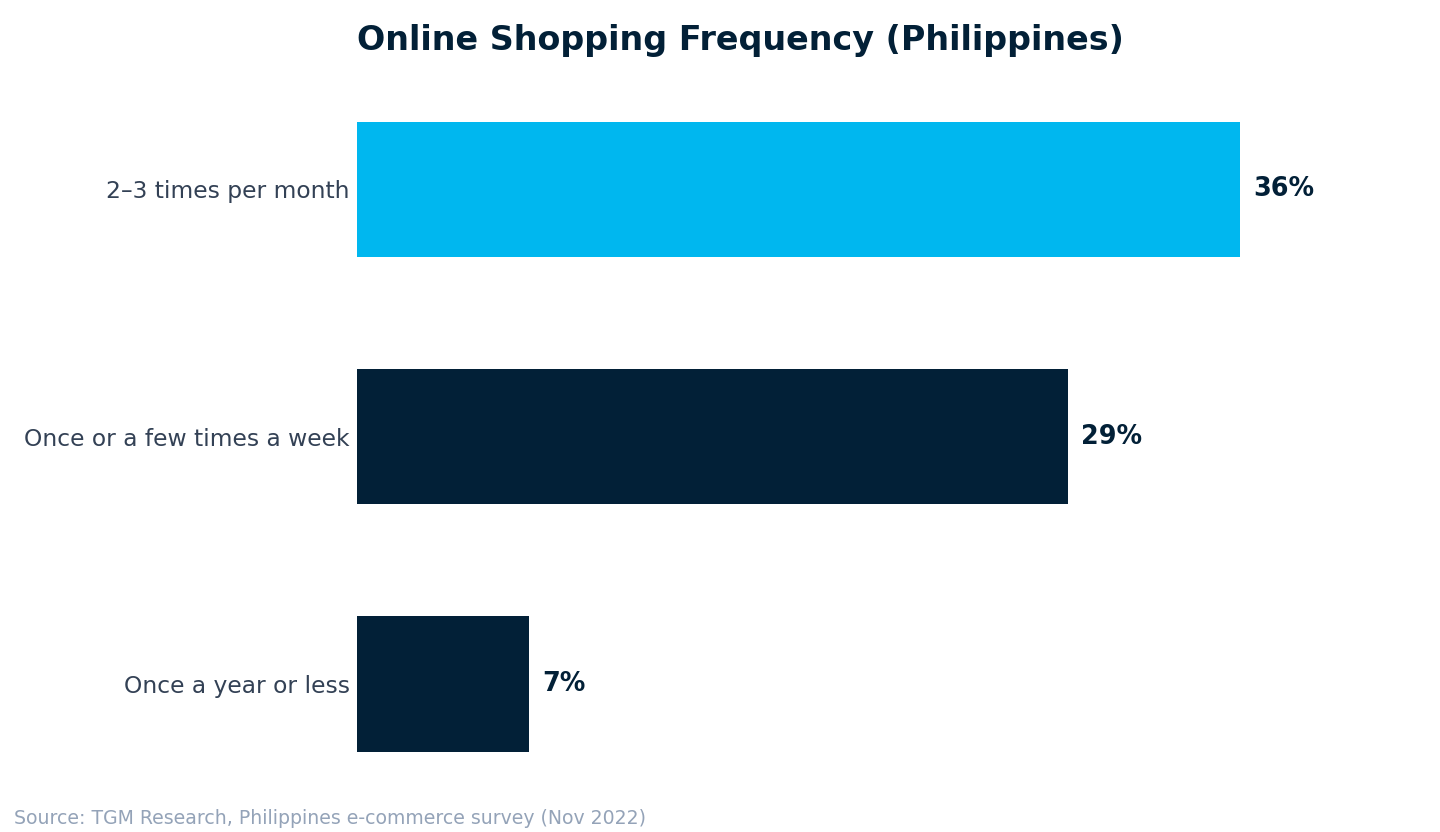
Use local digital behaviors to choose channels and survey design, but keep the claims tied to evidence from your sources. In TGM Research’s e-commerce survey in the Philippines (November 2022), 35% shopped online at least once per month in the past 12 months. The same survey reports that 29% shop online once or a few times a week, 36% purchase 2–3 times per month, and 7% shop once a year or less. Payment behavior also matters for screening and segmentation: TGM reports 62% preferred cash on delivery and 5% primarily used credit card. For brand context, respondents pointed to Shopee as the online shopping platform that comes to mind first when buying online.
Finally, align your panel’s segmentation to categories that matter in the local e-commerce environment. Ken Research describes the Philippines online retail and e-market as segmented by types such as Fashion and Apparel, Electronics and Gadgets, Home and Living, Health and Beauty, Groceries and Food, Sports and Outdoors, and Others, and notes Fashion and Apparel as the leading segment. The same source values the Philippines Online Retail and E-Market at approximately USD 15 billion. For qualitative depth, online communities can help you connect with younger demographics, particularly millennials and Gen Z, who are highly active online and comfortable sharing opinions in digital spaces.
What makes an online research panel in the Philippines different from a Metro Manila-only sample?
What profiling details should panelists provide during registration?
What do recent survey results say about online shopping frequency in the Philippines?
Which payment methods and platforms should e-commerce researchers account for in the Philippines?
How should teams think about incentives and operations for an online research panel in the Philippines?