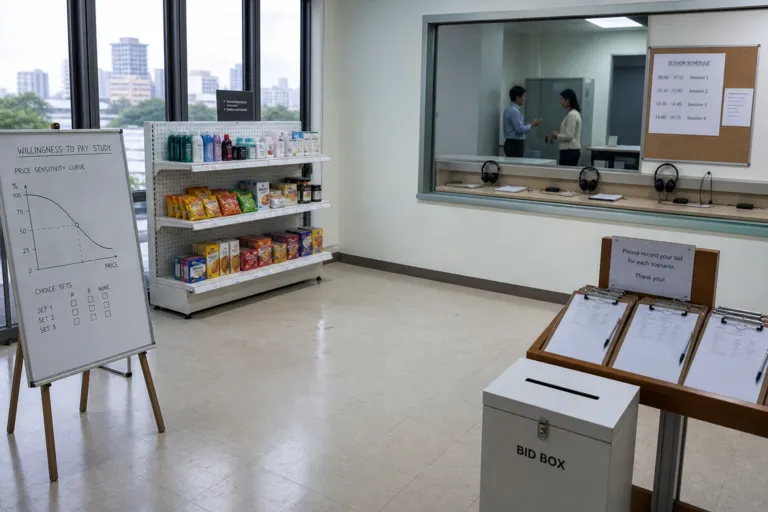
In pricing work, a stated willingness-to-pay number is tempting because it is fast, clean, and easy to present. But several sources warn that stated numbers routinely drift above real purchase behavior, because agreeing a price is easier than declining it, no money is spent in the moment, and participants do not have to give anything up to say yes. Instant Expert frames this as “hypothetical bias,” and cites a 2020 meta-analysis by Schmidt and Bijmolt that pooled 77 studies from 47 papers with 115 effect sizes. The meta-analysis reported an average hypothetical bias of 21%, meaning stated WTP ran above real WTP. Use that as a warning sign, not a one-size correction, because the same source notes the studies were about consumer goods and an average is not a correction factor for any specific market.
That gap becomes a process problem inside many organizations. Conveo describes a common pattern: teams collect willingness-to-pay survey data, then apply an inherited rule-of-thumb discount before presenting findings, and that adjustment is often larger than the effect being measured and rarely appears in the write-up. The practical fix is to measure the conditions attached to a price alongside the figure itself, so the correction becomes visible instead of instinctive. This matters because WTP is not a single number; it varies with the segments you sample, the purchase occasion, and the alternatives present. Revology Analytics also defines WTP as the maximum a customer or segment will accept before declining to purchase and emphasizes it is a distribution across customers that shifts with context and substitutes.
Methods That Work Better Than Asking for a Guess
For Vietnam-focused teams, stronger measurement usually means mixing methods that tie price to trade-offs and behavior. Product Focus recommends selecting tools by situation: interviews or Van Westendorp in early-stage work, conjoint analysis when an offering is complex or feature-rich, and A/B testing when you already have solid web traffic and a functioning product because it is based on actual customer actions. Mainbrain Research lists techniques that go beyond traditional surveys, including conjoint analysis, experimental auctions, and price-response studies, and suggests combining willingness-to-pay research with segmentation studies and behavioral analysis. Instant Expert adds an important nuance: indirect methods such as conjoint analysis can still overestimate real WTP, and in the Schmidt and Bijmolt meta-analysis they overestimated more than direct questions did, which runs against common assumptions.
If you want incentive alignment rather than “talk,” Instant Expert points to a 2011 Journal of Marketing Research study by Miller, Hofstetter, Krohmer, and Zhang. It compared open-ended questions, choice-based conjoint, and two incentive-aligned methods with real purchases. The source states the two incentive-aligned methods passed the authors’ statistical and decision tests, while also noting that even biased hypothetical methods could still point to the right pricing decision in some cases. In practice, this means Vietnam pricing teams can treat surveys as an upper estimate, then pressure-test the result with approaches that require a real buying step or a realistic choice structure, rather than relying on a single stated figure.
Vietnam also has evidence that non-traditional data collection can work at scale when designed carefully. A survey experiment in Vietnam by Gibson (Review of Development Economics, Wiley) tested using local expert knowledge to derive the mean and variance of prices for 64 consumer items in over 1000 communities, using photographs of specified items to ensure comparability. While this study is about consumer price data rather than product pricing tests, it reinforces a key principle for willingness-to-pay research in Vietnam: strengthen measurement with quality controls, cross-checks, and methods that improve comparability and context. For teams doing willingness to pay research in Vietnam, the most reliable path is usually a blended design—capture the “why” behind the number, map WTP as a range across segments, and validate with behavior-based steps where possible.
Why do stated willingness-to-pay surveys often overstate what people really pay?
What methods can reduce the gap between stated and real willingness to pay?
Is conjoint analysis always more accurate than direct WTP questions?
How should teams approach willingness to pay research in Vietnam without over-trusting survey numbers?