Market research cost Singapore teams should plan for depends on method, audience difficulty, incentives, tools, and project complexity. A common first split is between primary research (new, bespoke data) and secondary research (desk research using existing reports and published datasets). Primary work is described as more expensive and more time-consuming, while secondary work is typically less expensive and faster but less tailored. In Southeast Asia planning, projects often combine both approaches: desk research to map the landscape, then targeted primary research to validate product-market fit.
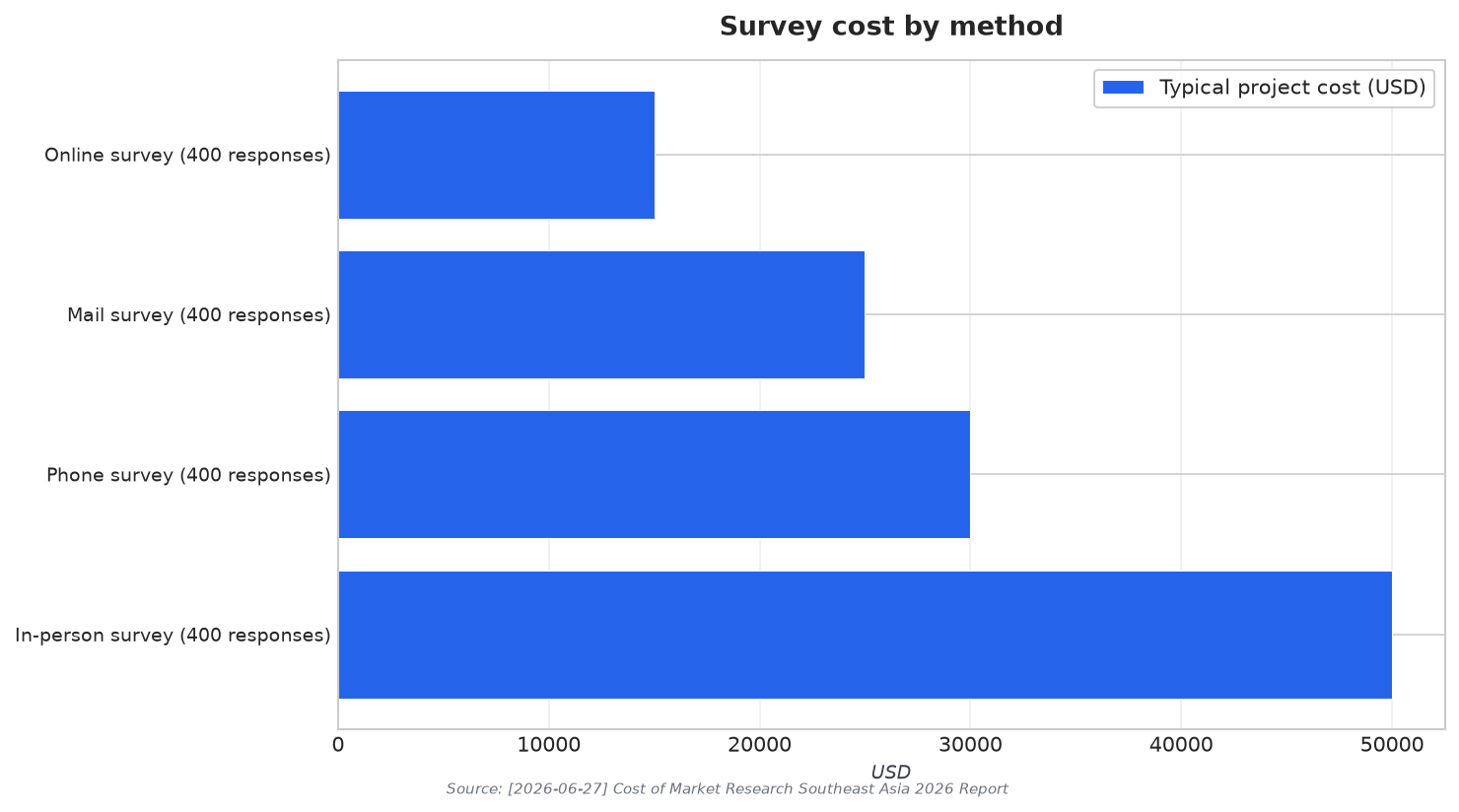
For budgeting, method-based ranges are useful as planning anchors, but many figures are global reference ranges rather than Singapore guarantees. A 2026 update lists online surveys at $5,000 to $15,000+ for 400 responses. Phone surveys are shown at $15,000 to $30,000+ for 400 responses, mail surveys at $10,000 to $25,000+ for 400 responses, and in-person surveys at $20,000 to $50,000+. On the qualitative side, in-depth interviews (IDIs) are listed at $5,000 to $15,000 per 10–15 interviews, and focus groups at $7,000 to $20,000+ per group, with focus group incentives often cited at $75–$150 per person.
Singapore Budget Signals: What Changes for Consumer vs B2B
To stay realistic for Singapore, pair global method ranges with local signals and audience dynamics. One Singapore-specific reference point states that focus group costs start from SGD 2,000, which can help anchor expectations for entry-level qualitative sessions in this market. Method design also matters. A Singapore guide describes focus groups as six to eight participants and notes that a typical project runs four to six sessions across different consumer segments, with sessions lasting 90 to 120 minutes. For bilingual moderation, English and Mandarin are standard, while Malay, Hokkien, and Cantonese capabilities become necessary for certain demographics such as older consumers, heartland audiences, and Malay-Muslim segments.
For B2B or hard-to-reach audiences, budgets can swing dramatically because the cost of reaching the right people dominates. One 2026 pricing guide notes that for surveys, sample plus incentives consistently eats 40% to 45% of the budget in two worked examples. It also states that four hundred general consumers might cost $1,600 in pure sample, while four hundred physicians, at the high end, could cost $200,000, even with the same survey length, analysis, and report. The same guide warns that for hard-to-reach B2B audiences, incentives alone can add $10,000 to $20,000 once the real incentive level needed to hit quota becomes clear.
When you benchmark spend, it also helps to align with how the industry operates. Globally, the market research industry was forecast to bring in $140 billion in revenue in 2024, up from $130 billion in 2023, and it grew by 37.25% from $102 billion in 2021 to $140 billion in 2024. Online/mobile quantitative services accounted for 35% of worldwide market research company revenues in 2022. In the same global context, online surveys are reported as the most used quantitative method, with 85% of market research professionals saying they use them regularly. For Singapore planning, these global figures are best treated as context for why survey-led projects are common, not as local pricing promises.
What drives market research costs in Singapore the most?
How much does a focus group cost in Singapore?
What are useful budget ranges for surveys when planning?
Why can B2B research cost more than consumer research?