For insight teams, GenAI can feel like a shortcut through the slowest parts of research work: drafting, summarising, searching, and reporting. Malaysian employees are already seeing time benefits. In the Malaysia findings of the EY 2025 Work Reimagined Survey (based on 300 employees and 30 employers across seven industries), 81% of Malaysian employees who actively use GenAI report significant time savings. But the same EY findings show the trade-off: 68% say their workload has increased. That combination matters for insight teams because faster output can expand the amount of work requested, unless leaders also redesign roles, review steps, and expectations.
A practical way to capture speed gains without letting risk spread is to treat adoption as a staged rollout, not a company-wide switch-on. Dr Muhamad Hariz Muhamad Adnan (drhariz.com), an HRD Corp certified AI trainer and Senior Lecturer at Universiti Pendidikan Sultan Idris (UPSI), recommends starting with two or three high-volume, low-risk workflows, then running a short pilot with a small team before scaling. For Malaysian teams, those workflows often include meeting notes and action extraction, summarising long reports for internal briefing, and drafting customer or vendor correspondence, including bilingual Bahasa Melayu–English drafting. The same roadmap also advises excluding final financial decisions, legal advice, regulated disclosures, or personal data you are not authorised to put into an external system.
Speed Gains Need Validation, Language Limits, and Clear Knowledge Flows
In insight work, polished language can hide weak reasoning. SEI Insights warns that GenAI produces insights that are fast, well-structured, and confident in tone, which can lead teams to accept outputs at face value if validation processes are missing. That risk increases when the team is working across languages, because bilingual drafting can introduce subtle shifts in meaning that are hard to spot in a quick review. This is why pilots should measure not only time saved, but also output quality judged by the same reviewers who normally sign off, and how often AI output needed substantial correction. When teams focus only on storage and access, MIT Sloan Management Review notes they can repeat old knowledge-management mistakes; leaders also need to manage knowledge flows, or how insights are created, analysed, stored, and accessed.
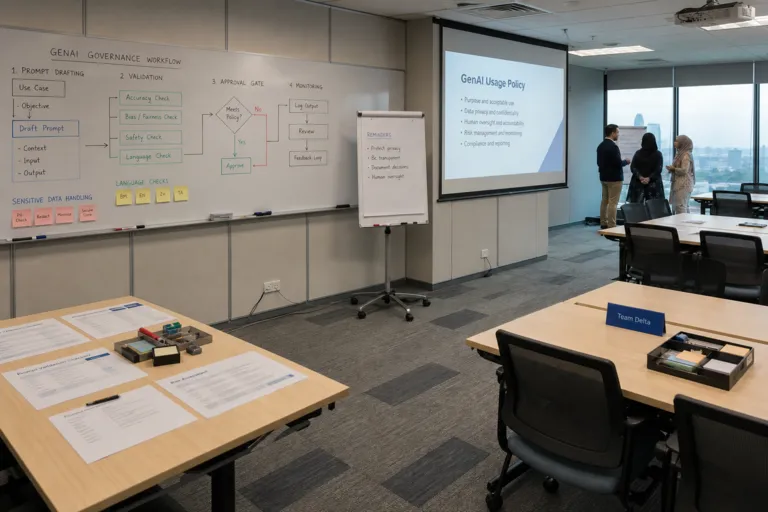
Governance is the other half of responsible adoption, and it must be written before scaling. Dr Hariz’s roadmap stresses putting a written usage and data policy in place before expansion, plus training every affected employee to a working baseline. EY’s Malaysia findings suggest why this is urgent: only 12% of Malaysian employees receive sufficient AI training to fully benefit from GenAI. For insight leaders, “sufficient” should include what can be shared with a tool, what must stay internal, and what always needs a human reviewer. SEI adds that GenAI does not fix poor data quality, unclear use cases, or limited governance; without these, it can scale problems as easily as it solves them.
Once the basics are in place, teams can use GenAI to reduce friction in analytics and retrieval without turning it into an ungoverned black box. MIT Sloan Management Review describes hybrid knowledge approaches that use retrieval-augmented generation (RAG) to integrate a company’s own customer insights with an LLM’s general knowledge base, helping employees access and summarise content in natural language. In analytics work, Mu Sigma highlights starting in high-friction areas like querying, reporting, and data preparation, and then expanding into insight generation and decision support with proper governance. If your goal is AI in market research Malaysia, the safest path is narrow at first: pick bounded workflows, constrain the data, validate outputs, and scale only when the team can prove quality and control.
What do Malaysian survey results show about GenAI productivity and workload?
How should a Malaysian insights team start adopting GenAI responsibly?
Why is validation critical when GenAI produces insight summaries?
How can hybrid approaches like RAG help customer and market insights work?
How can teams apply AI to market research work in Malaysia without over-sharing data?