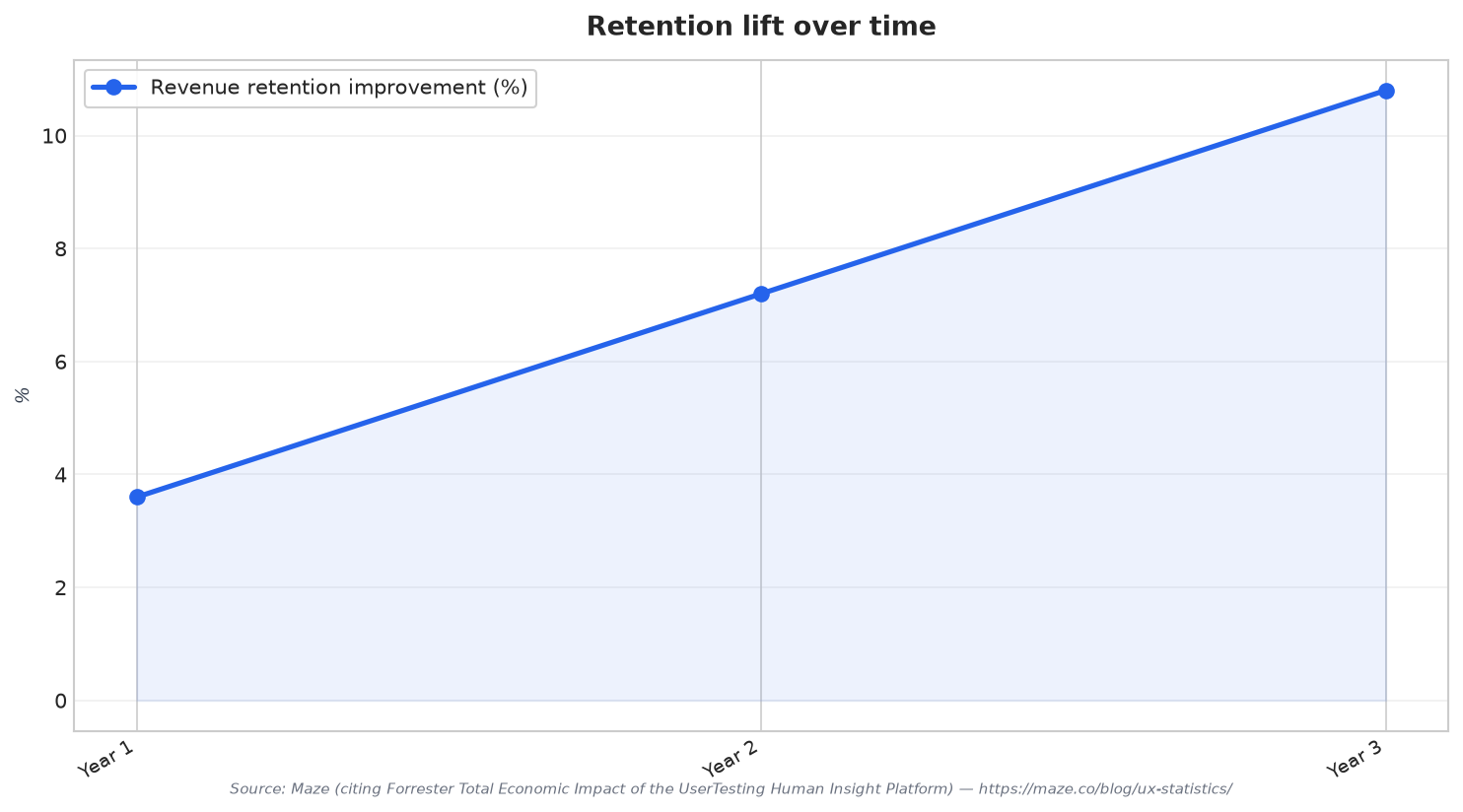
In Vietnam, mobile-first product teams need UX research that catches friction early and often. Global research summarized by Maze cites Forrester: every $1 invested in UX design can yield a return of $100 (ROI = 9,900%). The same source also highlights a modeled impact of continuous UX testing: revenue retention improvements that can reach 10.8% over three years, rising from 3.6% in year one to 7.2% in year two. These figures are not Vietnam-specific, but they are useful context when making the business case to prioritize research alongside delivery.
Mobile-first UX work is expanding globally, and that matters when you plan usability testing Vietnam programs around real device behavior. One market report notes that mobile-first UX testing represents 41% of new studies, in a world where global mobile traffic shares exceed 55% of total web usage. The same report states that remote and unmoderated usability testing accounts for about 44% of all UX research activities, and that session replay and heatmap analytics are embedded in nearly 47% of deployed platforms. For a Vietnam product roadmap, these global signals point toward faster cycles, more natural environments, and stronger evidence tied to actual interactions.
How to Structure Mobile-First Tests for Real-World Use
A practical way to operationalize mobile-first learning is to run short, repeatable studies with a focused sample. Userlytics recommends 8–20 participants and 15–30 minutes per participant for a mobile app usability test. Its mobile-first methods include a 5-second first impression check, direct success tasks for key flows like onboarding or checkout, gesture analysis for swipes and taps, and a one-handed usability rating to reveal thumb-zone reach issues. It also emphasizes outputs that help teams act quickly, such as screen-by-screen video replays, heatmaps, and success rates, plus early accessibility feedback on font sizes, button placement, and contrast.
Tools and workflows are also evolving toward speed and scale. A market report on UX research software says cloud solutions that support mobile UX testing, remote usability studies, and AI-powered sentiment analysis were used by 53% of tech startups and 46% of enterprises globally. It also reports that, between 2023 and 2024, remote usability testing adoption grew by 41%, and that eye-tracking analysis tools saw a 28% increase in enterprise-level adoption in 2024. Separately, another report states that these capabilities can reduce manual analysis time by 30–45% per research cycle, and that integration with product analytics and customer feedback systems is standard in over 69% of implementations.
For teams shipping across Southeast Asia, Vietnam is often one market inside a broader testing plan, and multi-language execution can change the pace of learning. UXArmy describes running multi-language unmoderated usability testing across Singapore, Thailand, Indonesia, Malaysia, Vietnam, and the Philippines. In that case study, the client was a major Southeast Asian e-commerce platform with 160 M+ monthly users, and UXArmy reports cutting research turnaround time by 60% while boosting onboarding completion by up to 15%. It also describes validating login and onboarding friction points across four languages in five working days, showing how ResearchOps (recruitment, screening, translation, transcription, synthesis) can compress timelines without removing user evidence.
Why does continuous UX research matter for mobile-first products?
What sample size and duration work for a mobile usability study?
Which methods are most useful in mobile-first usability testing?
How are tools changing for usability testing programs?
How should teams approach usability testing in Vietnam as part of Southeast Asia rollouts?