
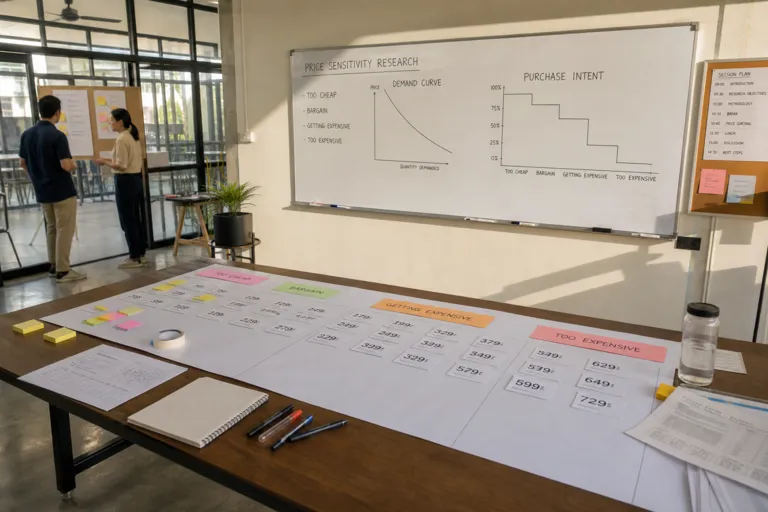
Doing pricing research for Thailand often feels like solving a puzzle with missing pieces: you need speed, clarity, and stakeholder confidence. Pricing is also a powerful lever. Marketbridge cites McKinsey: “pricing right is the fastest and most effective way for managers to increase profits…a price rise of 1 percent, if volumes remained stable, would generate an 8 percent increase in operating profits.” That kind of leverage is why survey-based pricing methods are popular when teams need simple, straightforward answers. Two of the most common approaches are the Van Westendorp Price Sensitivity Meter (PSM) and the Gabor-Granger model. Both are direct survey techniques, and both test your product largely in isolation rather than simulating head-to-head competition.
Van Westendorp is designed to surface price perception and acceptable ranges, especially early in the product lifecycle when you need directional guidance. Numerious describes four core questions: at what price is the product “too expensive,” “expensive but still worth it,” “a great value,” and “too cheap.” SurveyKing explains that analysis involves plotting cumulative response curves for each price point, which can help define acceptable ranges, pricing thresholds, and perceived optimal price points. The trade-off is that Van Westendorp typically does not ask whether respondents would actually purchase at specific prices. Numerious notes this can overstate or understate what is “optimal,” depending on how the product description aligns to the category and competitors.
How Gabor-Granger Adds Demand Curves and Revenue Precision
Gabor-Granger goes beyond “what feels fair” by explicitly measuring purchase intent at predefined prices. Marketbridge explains the flow: after respondents read a product or service description, they see a series of prices and indicate how likely they are to purchase at each price. If they accept a price, they are shown a higher (randomly chosen) price; if they reject it, they see a lower one, repeating until you find the highest price each respondent will pay. Quali-Fi summarizes the output as a demand curve and highlights a practical interpretation: the revenue-maximizing price is where revenue (price × purchase probability) peaks. This is also where Gabor-Granger helps quantify price elasticity and model scenarios, such as how much demand you lose at each higher price step.
For Thailand-focused teams, a pragmatic workflow is to use both methods sequentially. Campos notes that some researchers recommend starting with Van Westendorp “to get the lay of the land,” then using Gabor-Granger “for precision.” In practice, that means using Van Westendorp to identify an acceptable range, then selecting targeted price points for Gabor-Granger testing within that band. This pairing also addresses a known limitation: Van Westendorp captures perceptions and thresholds, while Gabor-Granger models purchase intent at explicit prices. Quali-Fi also recommends defining 5–7 price points across the range to build the demand curve, which can be especially helpful when you already know the competitive range and need revenue optimization within an established category.
Execution details matter as much as method choice. SurveyKing emphasizes that when using a research panel, screening and quotas become especially important to ensure the final sample reflects the target market and supports reliable pricing analysis. SurveyKing also recommends mixing question types: combine direct pricing methods (Van Westendorp or Gabor-Granger) with MaxDiff and usage data to segment pricing by the features customers actually use, which is critical for usage-based pricing. For budgeting context, SurveyKing states that pricing research projects start at $900 and include survey design, 200 panel responses, analysis, and reporting. It also lists self-serve studies starting at $19 per month, and custom design, analysis, and consulting starting at $100 per hour.
What is the practical difference between Van Westendorp and Gabor-Granger?
When should a Thailand team use Van Westendorp first?
How does Gabor-Granger find a revenue-optimizing price?
How can pricing research in Thailand be structured for both speed and precision?
What budget references exist for survey-based pricing work?