

For Singapore brands planning for a cookieless world, the most durable path is building a privacy-first first-party data strategy Singapore marketers can actually operate day to day. First-party data comes directly from real interactions: purchase history, surveys, loyalty behavior, website interactions, form fills, email engagement, CRM data, and product usage where available. It is also the practical counterpart to what many teams relied on for years: third-party cookies and pixels. One Martech Pulse audit illustrates the risk of “set-and-forget” tracking: a fintech client in Chicago had a retargeting pixel broken for four months without anyone noticing, leaving teams optimizing against data that did not exist. That kind of fragility is exactly what cookieless change exposes.
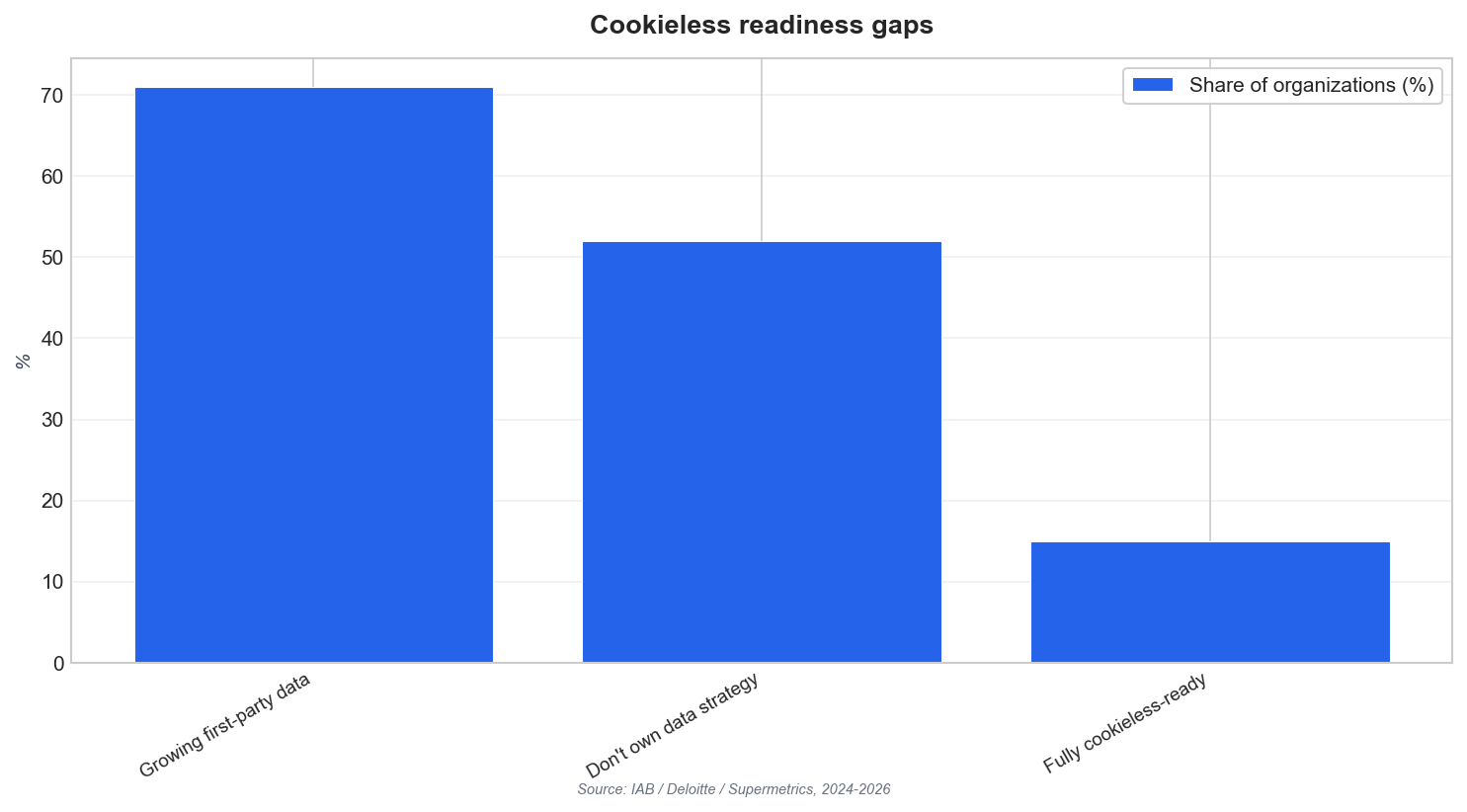
Global benchmarks show the strategic urgency, even if every figure does not describe Singapore specifically. IAB’s State of Data 2024 (n=500+ advertising and data experts) found 71% of brands, agencies, and publishers are growing or planning to grow first-party datasets, up from 41% two years earlier, and 95% of advertising and data decision-makers expect continued signal loss and privacy legislation. Readiness is uneven: Deloitte’s March 2025 survey reported only 15% of global marketers felt fully ready for a cookieless world. Meanwhile, Supermetrics’ 2026 Marketing Data Report (n=435) found 52% of marketing teams do not own their data strategy, and only 6% have fully embedded data-driven approaches into workflows.
What a First-Party Playbook Looks Like (and Why It Stalls)
A practical playbook is simple in principle: collect consented data customers give you directly, organize it so the team can use it, and wire it into the channels where you spend money. AudienceScience describes the common inputs as web behavior, app activity, email engagement, purchase history, support tickets, and quiz or preference-center responses. But many strategies stall due to plumbing, not vision. AudienceScience lists recurring blockers: no CDP foundation with customer data scattered across “8 disconnected tools,” consent mechanisms that fail to sync opt-outs downstream, identity resolution delayed to “phase 2,” and no activation pipeline—sometimes after “9 months and $400K” on a CDP—so audiences cannot be pushed cleanly into platforms like Meta or Amazon DSP.
When the foundation is sound, the business case can be strong. Google/BCG reports businesses using first-party data in marketing campaigns saw a 2.9x increase in revenue lift compared to those using other data sources. Forrester Consulting (2024) reports first-party data improves customer acquisition costs by up to 83% and conversions by 73%, while McKinsey’s personalization research cited in the Omnibound compilation notes customer acquisition costs can be reduced by up to 50%. For execution reality checks, Salesforce’s State of Marketing (9th edition) says 72% of marketers worldwide use CDPs alongside other tools, and TechRT reports 78% of enterprise companies have adopted CDPs.
Measurement has to change with the data. Acquia cites a 2023 Econsultancy report where only 29% of survey respondents felt their organization had a robust measurement system for the cookieless future, which makes it hard to prove progress. Aumcore recommends incrementality testing, cohort analysis, and closed-loop reporting that ties leads and customers back to original campaigns using CRM and CDP data, while monitoring “consent health” indicators like opt-in rates, unsubscribes, and data quality trends. Martech Pulse’s example shows what “better inputs” can unlock: after iOS 14 reduced tracking, a skincare founder added a simple “What’s your skin type?” quiz, built an email list, and within six months saw email open rates around 45% versus an industry average of 10–25%.
What is the core of a first-party data strategy for Singapore brands?
Why are brands shifting to first-party data as cookies fade?
What are the most common reasons first-party programs stall?
How should teams measure results in a cookieless era?
What’s an example of a first-party tactic replacing lost tracking?