

Southeast Asia Africa business is evolving beyond exports and commodity transactions. Companies are developing local manufacturing, integrated supply chains, regional distribution platforms, and more structured investment partnerships, changing how businesses operate across both regions.
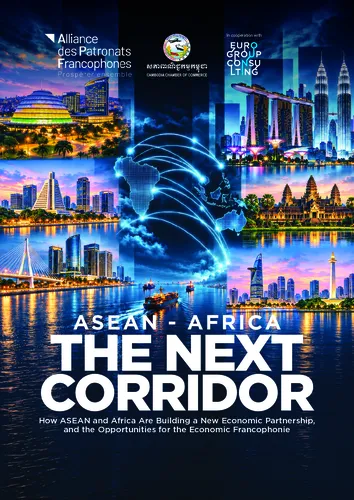
ASEAN–Africa: The Next Corridor, developed by Eurogroup Consulting in collaboration with the Alliance des Patronats Francophones (APF) and the Cambodia Chamber of Commerce (CCC), identifies five emerging shifts that could reshape these relationships through 2035.
Launched at REF 2026 in Phnom Penh on 14 November, the whitepaper examines how companies are moving from individual transactions toward longer-term commercial operations.
For Southeast Asian executives, these shifts provide a framework for evaluating Africa expansion strategies.
Why Are ASEAN Companies Moving From Exports to Local Production?
Exporting can provide initial access to African markets. However, local manufacturing may become more competitive once demand reaches sufficient scale.
Freight costs, tariffs, currency exposure, and delivery times can affect the economics of supplying products from Southeast Asia.
Singapore-based Tolaram illustrates this transition.
The company introduced Indonesia's Indomie instant noodles to Nigeria in 1988 before establishing local manufacturing in 1995–1996. According to Enterprise Singapore information cited in the whitepaper, Tolaram subsequently developed a platform comprising 13 manufacturing plants in Nigeria.
Its expansion demonstrates how an imported product can become the foundation for a broader industrial operation.
However, local production is not automatically preferable. Investment must be justified by customer demand, suitable infrastructure, and sustainable operating costs.
The ASEAN–Africa: The Next Corridor whitepaper examines how localization could develop across selected industries.
Integrated Value Chains Are Replacing Simple Commodity Relationships
The second shift concerns how businesses distribute production and processing activities across both regions.
African producers are developing greater local processing capacity, while ASEAN companies retain important advantages in specialized manufacturing and distribution.
This is visible in agriculture, industrial materials, and consumer products.
Rather than relocating entire industries, companies can identify which activities are most competitive in each market.
For example, African agricultural producers may expand primary processing while Southeast Asian companies focus on specialized manufacturing, product development, or international distribution.
The commercial opportunity lies in coordinating these activities into efficient value chains.
For companies evaluating expansion, market research and strategic analysis can help determine which production activities offer commercially viable opportunities.
ASEAN Is Broadening Africa's Range of Asian Partners
China remains a much larger commercial partner for Africa, but ASEAN offers complementary industrial and operating capabilities.
The whitepaper reports China–Africa merchandise trade of approximately US$295.6 billion in 2024, compared with US$59 billion between ASEAN and Africa in the same year.
The comparison illustrates the difference in scale, while also highlighting room for Southeast Asian companies to develop their presence.

ASEAN businesses contribute capabilities across several industries:
- Manufacturing: Thailand, Malaysia, Indonesia, and Vietnam have established industrial ecosystems.
- Infrastructure and finance: Singapore provides capital, corporate networks, and specialist services.
- Consumer services: Southeast Asian companies bring experience in hospitality, distribution, and consumer products.
- Technology: Telecommunications and digital platforms offer additional opportunities for cooperation.
As Moukaramou Chanou Alao, Managing Director of Ecobank International, argues in the whitepaper:
"We must now change scale and method: move from a relationship founded on trade to industrialisation, investment programmes and genuine partnerships."
His observation highlights the importance of developing operating partnerships rather than relying solely on trade growth.
From Individual Markets to Regional African Platforms
The fourth shift concerns regional market access.
Companies have traditionally expanded through separate relationships in individual African countries. Improved logistics networks and regional integration could make shared operating platforms more viable.
Under full implementation of the African Continental Free Trade Area (AfCFTA), the World Bank projects a 110% increase in intra-African manufacturing exports by 2035, as cited in the whitepaper.
This could strengthen the economics of manufacturing and distribution platforms serving neighboring countries.
However, progress will depend on infrastructure, customs implementation, and operating conditions.
Companies should not assume that regional agreements eliminate the need for country-specific market assessments.
Business Networks Are Becoming Investment Ecosystems
The final shift involves connecting commercial introductions with financing and implementation.
Organizations such as the Africa Southeast Asia Chamber of Commerce (ASEACC) are developing mechanisms that extend beyond traditional networking.
Africa SEA Capital, established in 2024, illustrates this transition. The investment vehicle was created to mobilize Southeast Asian capital toward African opportunities, including participation in Africa Finance Corporation.
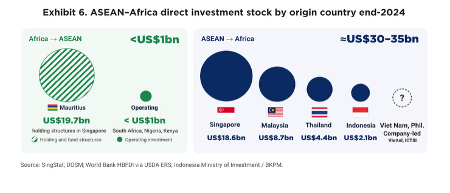
These developments could strengthen the business infrastructure supporting cross-regional investment. According to the whitepaper, Singapore reported approximately US$18.6 billion in direct investment stock in Africa at the end of 2024, followed by Malaysia at US$8.7 billion.
For executives, the relevant considerations include partner credibility, financing arrangements, transaction readiness, and the ability to build repeatable operations.
Market research remains essential for identifying opportunities that match a company's capabilities and commercial objectives.
Frequently Asked Questions
Why are Southeast Asian companies manufacturing in Africa?
Local production may reduce freight costs, shorten delivery times, and improve product adaptation when demand reaches sufficient scale. However, manufacturing economics depend on energy availability, infrastructure, workforce capabilities, and market access. Exporting may remain preferable where domestic operations cannot achieve competitive costs.
Which ASEAN company provides an example of African localization?
Singapore-based Tolaram offers an established example. After introducing Indomie to Nigeria through imports, it developed local manufacturing, distribution, and supporting industrial activities. The case demonstrates how a consumer product can become the foundation for a broader African operating platform.
How could the AfCFTA affect Southeast Asian companies?
The African Continental Free Trade Area could support regional manufacturing and distribution by reducing barriers between participating African markets. Its commercial benefits depend on implementation, infrastructure, and national regulations. Businesses should assess specific markets and trade routes before establishing regional operations.
What is changing in Southeast Asia–Africa business relationships?
Commercial relationships are extending from exports toward manufacturing, integrated value chains, investment platforms, and organized business networks. These shifts could support longer-term economic cooperation, provided companies can identify viable demand, secure financing, establish trusted partnerships, and develop reliable operations.
Explore the Next Phase of Southeast Asia–Africa Business
The changing corridor creates opportunities for manufacturers, investors, and service providers seeking new markets and long-term partnerships.
For executives assessing these developments, the full whitepaper explores five emerging shifts, seven priority sectors, and the practical enablers supporting economic integration.