
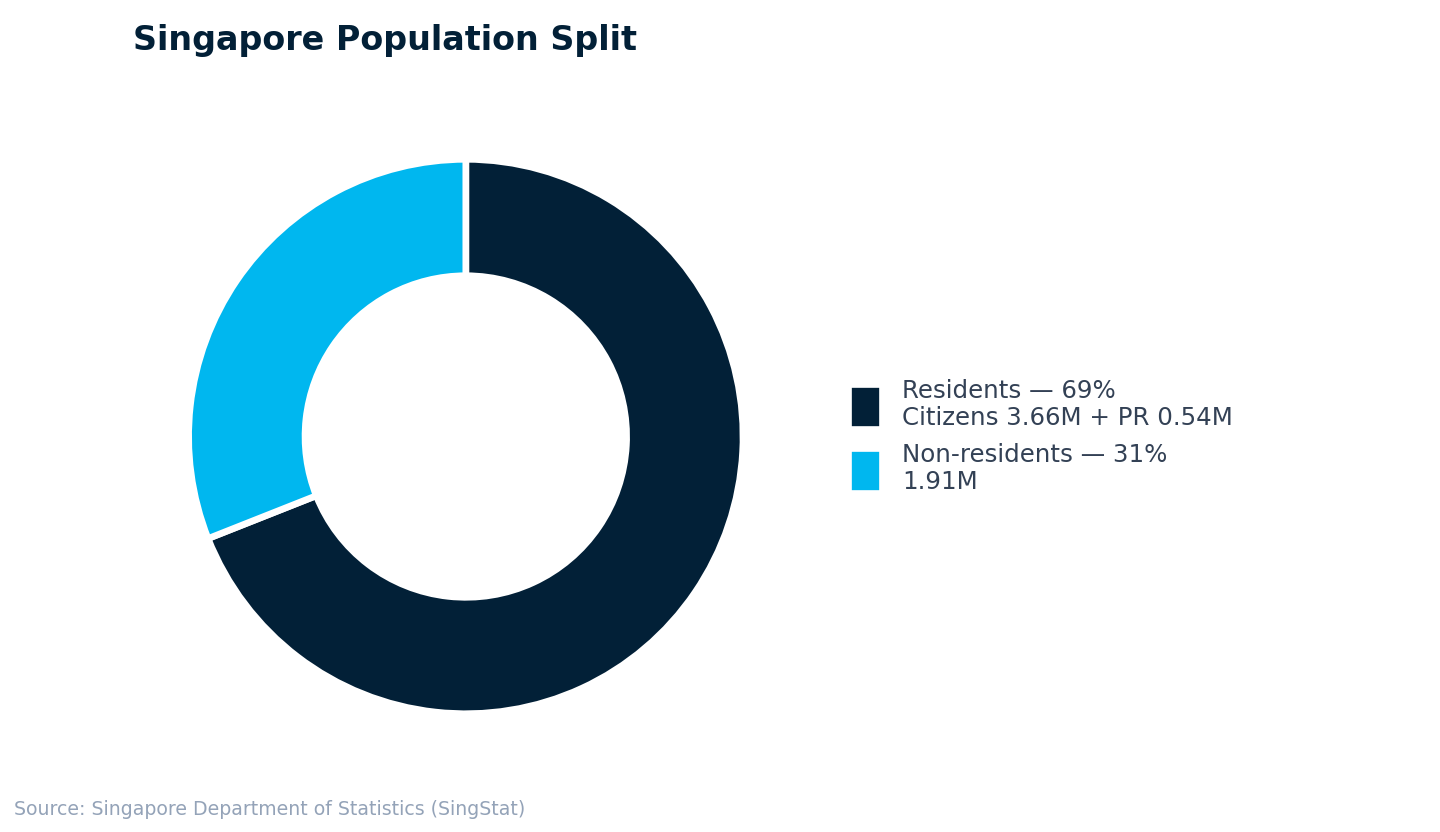
Building a first-party data strategy for market research in Singapore starts with clarity on what you need to learn and who you are studying. Singapore’s population splits into two fundamental markets: residents at 69% (citizens 3.66M and permanent residents 0.54M) and non-residents at 31% (1.91M). These groups can behave differently, from long-term stability-driven decisions to more transient needs. Your plan should also account for Singapore’s multicultural fabric: Chinese 74.3%, Malay 13.5%, Indian 9.0%, and Others 3.2%. A single generic survey or loyalty flow risks missing nuance across segments, languages, and expectations.
Use official data to set the baseline before you collect anything from customers. Singapore’s Department of Statistics (SingStat) is positioned as a “source of truth” for credible data on the economy and population, with tools like the “Data for Businesses” dashboard, the Household Expenditure Survey (HES), and the SingStat mobile app offering access to key indicators and over 300 charts. SingStat also describes AI-ready access to official data through the SingStat MCP, enabling query and retrieval while using other AI chatbots and AI-powered applications. This kind of foundation helps you define hypotheses, choose the right segments, and avoid over-collecting personal data you do not need.
Design Consent-Led Collection That Fits Singapore’s Digital Reality
Singapore is a “digital default” environment, and the sources note cellular connections exceed 162% of the population, indicating widespread multi-device usage across residents and non-residents. That makes mobile-optimised touchpoints the baseline for collecting first-party signals such as preference centers, post-purchase feedback, and membership profiles. In retail specifically, the market context points to stronger loyalty playbooks that build first-party data reservoirs for compliant personalization under PDPC rules. It also highlights that privacy rules require clear consent for personalization, and that consent requirements and algorithm transparency rules reshape how personalization can be executed. For market research, that means your questionnaires, incentives, and analytics should be built around explicit permission and explainable use cases.
Once data is collected, the hard part is making it usable across systems. A cited challenge is that similar customer data is often stored in different formats, updated on different schedules, and is usually not consistent. A data standardization strategy defines how each data type should be formatted and stored, and how it is updated across systems. This is essential if you want market research outputs to be repeatable across waves, channels, and business units. Standardization also supports cleaner segmentation that reflects Singapore realities, such as differences between resident and non-resident needs or the implications of a median age of 43.2 years (2025) and life expectancy of 83.5 years when testing senior-oriented products and services.
Finally, connect first-party insight to operational choices and infrastructure constraints so research translates into action. Singapore’s economy is framed as high purchasing power, with GDP per capita (PPP) described at about $157,000, and the sources note Singapore holds an AAA sovereign credit rating and is the only country in Asia with this top rating from all major agencies. On the delivery side, the data center context shows a technology environment where latency and compliance matter, including a cited PUE as low as 1.03 for a GPU-as-a-Service bundle hosted in STT Singapore 6, and a build slated for 2027 delivery (ST Engineering, Jalan Boon Lay). Tie these realities back to research design: prioritize questions that inform premium positioning, omnichannel convenience, and consent-led personalization that can be sustained with consistent data operations.
How do I start a first-party data strategy for market research in Singapore?
What Singapore-specific segments should my research plan consider?
Why does consent matter so much when building first-party data for retail personalization?
What is data standardization, and why is it critical for first-party insight?
How does Singapore’s digital behavior affect first-party data collection?