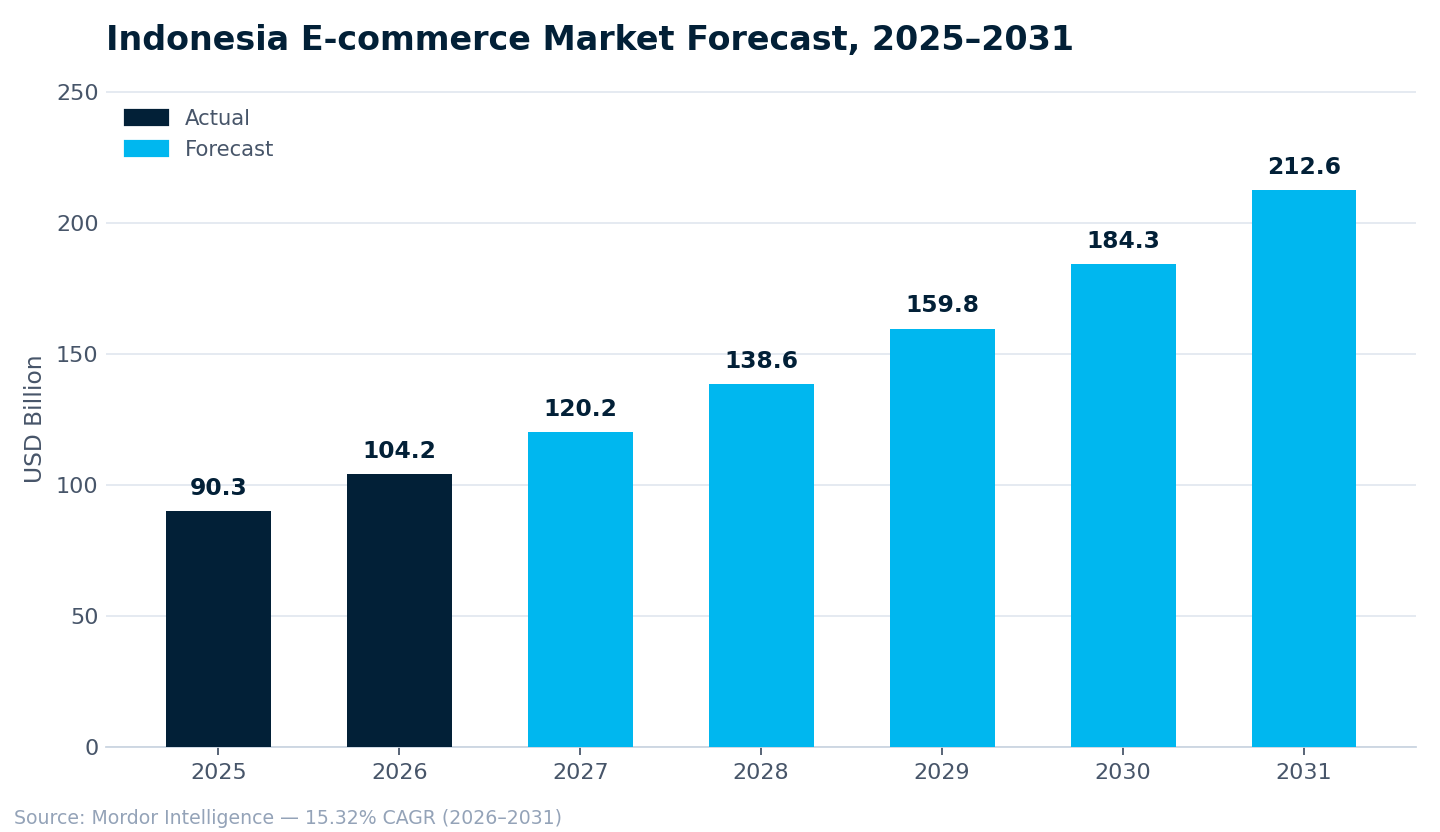
Designing effective B2B market research Indonesia studies begins with clarity on the decision you need to make. The market landscape is shaped by fast-moving digital channels and enterprise infrastructure shifts. For context, Mordor Intelligence forecasts Indonesia’s e-commerce market to grow from USD 90.35 billion in 2025 to USD 104.21 billion in 2026, and reach USD 212.58 billion by 2031, with a 15.32% CAGR over 2026–2031. In that same report, B2C held 86.90% share in 2025, while the B2B segment is projected to expand at an 18.74% CAGR to 2031. Those directional signals help you frame hypotheses, segment priorities, and the questions your study must answer.
Sampling is where many Indonesia studies fail, especially when teams default to urban online panels. Iconic Research notes that online panels skew heavily toward Java and urban demographics, and that designs built on urban online panels produce findings representing approximately 30% of the actual consumer base. Even for B2B work, these biases can distort insights when your buyers, channels, or operations span multiple islands. A nationally representative sample requires deliberate geographic stratification, at least across Java, Sumatra, and other islands. Build quotas and recruiting criteria that reflect where your target accounts operate, not simply where respondents are easiest to reach. This is also where language and regional dynamics matter, because regional dialects can influence instrument design and group candour.
Build a Mixed-Method Design That Reduces Bias and Improves Decision Usefulness
Mixed methods can raise confidence when you need to understand both motivations and measurable patterns. A case study on PT Kazee Digital Indonesia used a mixed method approach that started with in-depth interviews and internal focus group discussions to explore motivations, risks, and decision criteria. It then moved to an Analytical Hierarchy Process (AHP) model and paired comparison questionnaires with ten internal participants from various divisions. This is a useful template for B2B research design: explore first, then quantify trade-offs. Iconic Research also warns that Indonesian respondents can show social desirability bias in formal settings, stating preferred answers rather than actual behavior. To address this, incorporate approaches such as projective techniques, ethnographic observation, or in-home placement studies where relevant, so you can validate what people say against what they do.
Sector context should shape your questionnaire, segmentation, and interpretation rules. In Indonesia’s B2B telecom market, Mordor Intelligence values the market at USD 1.88 billion in 2025 and estimates growth from USD 1.91 billion in 2026 to USD 2.05 billion by 2031 (1.43% CAGR over 2026–2031). The same source reports mobile connectivity leading with 57.40% revenue share in 2025, large enterprises holding 60.30% share, and data and internet services accounting for 53.20% in 2025. It also notes BFSI leading with 21.60% revenue share in 2025, while manufacturing is forecast to expand at a 6.78% CAGR to 2031. Use these splits to structure your sample and reporting cuts, so your insights map to how suppliers actually organize offerings and how buyers evaluate risk and compliance.
Finally, plan your analysis workflow before fieldwork starts, so outputs remain decision-ready. SIS International recommends data cleaning to remove inaccuracies, duplicates, or incomplete entries, and using statistical techniques to identify patterns, correlations, and trends. It also highlights the value of using existing reports and industry publications as a cost-effective way to gather insights. In Indonesia’s e-commerce environment, device and payment behavior are also relevant contextual variables: smartphones captured 69.40% of market size in 2025, digital wallets led with 40.60% revenue share in 2025, and BNPL is advancing at a 27.10% CAGR through 2031. These inputs do not replace primary research, but they help you define realistic screening criteria, build segmentation, and turn findings into clear next steps for product, pricing, channels, and enterprise go-to-market planning.
How do you design B2B market research studies in Indonesia that avoid urban-only bias?
What is a practical mixed-method structure for Indonesia B2B research?
Which Indonesia B2B telecom segments can guide sampling and segmentation?
What secondary context can strengthen research design for Indonesia’s digital buying environment?